Overview — what it does
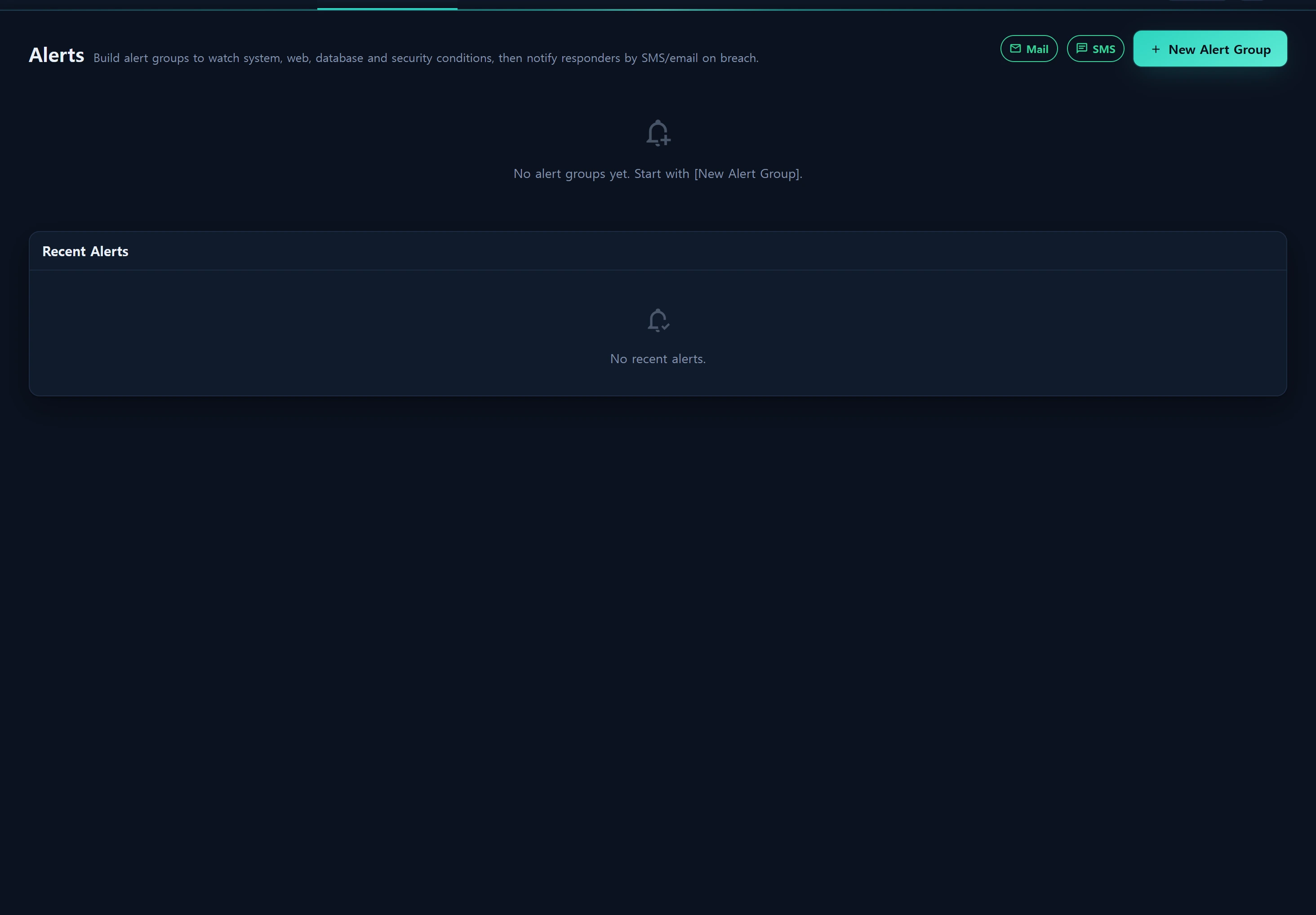
Infrastructure ▸ Alerts (/infra/alert) is the alert-group (policy) console. An operator adds conditions across four areas (system / web / DB / security) to a single policy (infr_alert_policy), tunes each threshold factor on screen, and when a breach occurs the group's recipients (infr_alert_recipient) are notified by SMS/email automatically.
It replaces the old "Capacity & Alerts" page (/infra/capacity), which now redirects here.
Key characteristics:
- A policy is one monitoring bundle: severity, re-alert suppression (cooldown), areas, conditions, channels, and recipients all live on one card. Create several policies split by team or shift (e.g. "Infra night on-call", "Security ops").
- Evaluation and dispatch are separated:
AlertEvaluatorevaluates conditions;AlertDispatcheropens alerts and sends. Both are shared by the console [Check now] button and the scheduled commandinfr:eval-alerts. - Dedup, cooldown, batch, auto-close: repeated breaches collapse into one alert, re-sends are suppressed during cooldown, a policy's notifications are batched into one message (prevents SMS floods), and alerts auto-close when the breach clears.
- Read-only live data: system from
server_status, DB frominfr_db_metric, security fromlegacy_glorydetection tables, web from a live HTTP probe. Web cert-expiry scansinfr_web_certglobally.
This screen manages only policies, alerts, and delivery history. For per-server graphs see Servers; for web uptime see Service ▸ Web; for DB load see Service ▸ Database. Threshold defaults are defined in Operations Policy.
When to use
- You want immediate notice when a server's load average or free disk crosses a danger line.
- You want on-call notified when a landing URL is down (unexpected status / no response) or responds slowly.
- You want continuous watch for failed TLS auto-renewal on registered web services (cert about to expire).
- You want alerts when a registered DB's pending queue backs up or hourly slow-query count spikes.
- You want to broadcast breach signals to the team: IDS alert floods, AI anomaly-block surges, new blocked-IP surges.
Layout
Policy card grid
Each policy renders as one card summarizing its active toggle, severity badge, enabled areas, and recipient count, with these actions:
| Action | Description | Access |
|---|---|---|
| Active/paused toggle | is_active — whether the scheduler evaluates it |
level≥2 |
| Edit | Modal for areas, conditions, channels, recipients | level≥2 |
| Check now | Evaluate + dispatch this policy immediately (run) |
level≥2 |
| Test | Send a test mail/SMS to recipients now (test) |
level≥2 |
| Delete | Remove policy + recipients | level≥2 |
| Drag reorder | Display/evaluation order (seq, reorder) |
level≥2 |
Edit modal (areas, conditions, channels, recipients)
- Basic: name, severity (info/warn/crit), re-alert suppression (minutes), active, note.
- Alert areas: enable system / web / DB / security (system on by default).
- Conditions: per enabled area, on/off + threshold factor (see condition catalog below).
- Channels: SMS and mail. Actual delivery requires a provider in Mail Adapters/SMS Adapters; the card warns when no provider is configured.
- Recipients (repeater): name, email, phone +
via_mail/via_smschecks. The effective channel is the intersection of policy channels ∩ recipient via_*.
Recent alerts feed
Shows infr_alert ordered by last_seen desc, up to 60 rows (30s polling). Each row shows the observed value, threshold, aggregate count, and sent ok/total (from infr_alert_delivery), with [Ack] and [Close] status transitions.
How to use
1) Create a policy
- [New alert group] → enter name, severity, cooldown.
- Enable the areas you want to watch.
- For each area, enable conditions and adjust threshold factors. Defaults are prefilled from Operations Policy
alertDefaults(). - Pick channels (SMS/mail) and add recipients.
- Save.
2) Condition catalog
System (server_status, seq window)
| Condition | Toggle | Factor | Default | Emitted metric |
|---|---|---|---|---|
| Load average over | sys_load_on |
sys_load_max |
20 | load_avg (>20, per server) |
| Free disk below | sys_disk_on |
sys_disk_free_mb |
500 | disk_free (<500MB) |
- Target defaults to all servers (
targets.system.all=true); you can narrow to selected aliases (max 200). - The snapshot reads only the latest seq window (
distinct seq desc limit 3) to avoid slow queries (inherited from HealthService). Offline / no-data servers are not judged — a server must haveloadavgin the latest 2 cycles to be online. - Free disk uses the tightest partition among
df-,df-data,df-home(DfParse::availableGb).
Web (live HTTP probe · infr_web_cert)
| Condition | Toggle | Factor | Default | Emitted metric |
|---|---|---|---|---|
| Service OFF (status ≠ expected) | web_code_on |
web_expect_code |
200 | http_status |
| Latency over | web_latency_on |
web_latency_ms |
5000 | latency |
| Cert expiry imminent | web_cert_on |
web_cert_hours |
48 | cert_expiry |
- Target URLs come from
targets.web.urls[](with labels, max 30 per policy). Each evaluation cycle requests them directly viaHttp::connectTimeout(4)->withoutVerifying()->get(). A status different from expected, or a connection failure/timeout, is treated as service OFF (when the code condition is on). - Cert-expiry is a single toggle but the scan is global: independent of the policy's target URLs, it sweeps the
infr_web_certrecords for every domain of every registered web service and raises a breach for each domain expiring within the threshold (web_cert_hours, default 48h) — up to 50 per evaluation. Certificates are refreshed on a 6-hour rotation by WebProbeService. This catches a failed auto-renewal before an expiry surprises anyone.
Enabling just "Cert expiry imminent" watches every site's certificate. It is not per-site — it is a global scan across all domains.
Database (infr_db_metric latest sample)
| Condition | Toggle | Factor | Default | Emitted metric |
|---|---|---|---|---|
| Pending queue rising | db_waiting_on |
db_waiting_max |
5 | db_waiting (>=5) |
| Hourly slow query | db_slow_on |
db_slow_per_hour |
60 | db_slow (slow_qps×3600 >= 60) |
- Targets are
targets.database.collectors[](access=database collector keys). If no target is selected, nothing is evaluated. - It reads
DbCollectorService::latest($collector)but only judges samples that areokand under 10 minutes old (avoids stale false positives). Register/collect via DB Collectors.
Security (legacy_glory detection tables · composite)
The evaluation window is sec_window_min (default 10 min). Any one signal over its threshold fires a breach.
| Condition | Toggle | Factor | Default | Source |
|---|---|---|---|---|
| IDS severity + count | sec_ids_on |
sec_ids_severity, sec_ids_count |
2, 20 | suricata_alert_ct (severity≥S, in-window count≥N) |
| AI anomaly-block surge | sec_kitsune_on |
sec_kitsune_count |
5 | kitsune_detail_log (is_blocked=1, count≥N) |
| New blocked-IP surge | sec_blacklist_on |
sec_blacklist_count |
10 | blacklist_info (new created_at in window, count≥N) |
Related: Threats · Detections · Blocklist.
3) Check now / Test
- [Check now] (
run): runsevaluate()→handle()for this one policy immediately and returns a breach/sent summary (breaches :b · sent :s) plus the refreshed feed. Use it to confirm a condition actually fires without waiting for the scheduler. - [Test] (
test): sends a test mail/SMS to active recipients right now to confirm the channel works (independent of any breach — a provider health check).
4) Automatic evaluation (schedule)
Active policies are evaluated and dispatched automatically every minute.
Schedule::command('infr:eval-alerts --quiet-if-ok')
    ->everyMinute()
    ->withoutOverlapping(2)
    ->onOneServer()
    ->when($is_leader);
Manual runs:
# Evaluate all active policies (single-shot, exits after — not a daemon)
php artisan infr:eval-alerts

# A single policy only
php artisan infr:eval-alerts --policy=12

# Suppress output when there is no breach (scheduler default)
php artisan infr:eval-alerts --quiet-if-ok
infr:eval-alertsis a single-shot command that exits (it loops the policies and returns). Never turn it into an infinite-loop daemon — spawning a never-exiting daemon from the scheduler exhausts shared DB connections (see the pulse:check connection-leak lesson). The scheduler safely launches a fresh instance every minute.
Data sources
Write tables (new infr_)
| Table | Migration | Role |
|---|---|---|
infr_alert_policy |
000700 | Alert group (policy). scopes/targets/conditions/channels JSON + severity, cooldown_min, seq |
infr_alert_recipient |
000701 | Per-policy recipients (inline). email/phone + via_mail/via_sms/is_active/seq |
infr_alert |
000702 | Alert instance (fire log / triage queue). Dedup key (policy_id, metric, entity_key, status='open'), notified_at cooldown |
infr_alert_delivery |
000703 | Delivery history. channel/address/ok/provider_code/message_id/error/latency_ms |
Read sources (legacy + new, read-only)
- System:
server_status(legacyconnection, part=loadavg/df-*). - Web: live HTTP GET (target URLs) +
infr_web_cert(cert expiry). - DB:
infr_db_metric(populated by access=database collectors). - Security:
suricata_alert_ct,kitsune_detail_log,blacklist_infoonlegacy_glory.
Dedup / cooldown / auto-close flow
AlertEvaluator::evaluate($policy)→ array of breach candidates per active area. Area exceptions are isolated (one area failing does not block the rest).AlertDispatcher::handle($policy, $breaches):- Each breach is looked up by
(policy_id, metric, entity_key, status=open)→ if found, update +count++; else insert new (first_seen, count=1, notified_at=null). - Notifiable = new OR
notified_atnull ORnotified_at <= now - cooldown_min. - Auto-close: open alerts of this policy not present in this round's breaches →
status='closed'. - Batch send: notifiable alerts are bundled into one message per recipient per channel (body max 8 lines, overflow "+N more"; SMS capped at 140 chars). After sending, each target's
notified_at=now. - One
infr_alert_deliveryrow per (recipient, channel).
- Each breach is looked up by
Access
| Operation | Min level | Audit |
|---|---|---|
| View console/list/feed (index/list/feed) | 1 (read) | — |
| Save/delete/reorder policy (save/delete/reorder) | 2 (write) | alert_policy.create / .update / .delete |
| Alert ack/close | 2 | alert.ack / alert.closed |
| Check now (run) | 2 | alert.fire on send |
| Test send (test) | 2 | alert.test |
| Scheduled auto-send | (system) | alert.fire |
Level scale: demo=1 · staff=5 · admin=10. Reads require level≥1; writes and dispatch require level≥2. All destructive/dispatch operations are recorded in infr_audit_log (see Audit Log). Delivery-channel providers are configured by an admin (level≥10).
Troubleshooting & FAQ
Q. I enabled a condition but no alert arrives.
- Confirm the policy is active and the scheduler (
schedule:work/ prod supervisor) is running. - No channel provider — check the card warning and configure a default provider in Mail Adapters/SMS Adapters.
- Verify the intersection of recipient
via_mail/via_smswith the policy channels is non-empty, and that email/phone are filled. - During cooldown, re-sends are suppressed (
cooldown_min, default 30 min). Use [Check now] to verify immediately, but an already-notified alert only re-sends after cooldown passes.
Q. My DB/system conditions stay quiet.
- System: the target server must be online (loadavg in the latest 2 seq cycles) to be judged. Offline/no-data is skipped.
- DB: the
infr_db_metriclatest sample must be ok and under 10 minutes old. Confirm the collector is running in DB Collectors.
Q. Does cert-expiry watch only a specific site?
- No.
web_cert_onis a global scan — it sweepsinfr_web_certfor every domain of every registered web service, independent of the policy's target URLs.
Q. Does the same breach keep piling up?
- No. It aggregates onto one open alert keyed by
(policy_id, metric, entity_key)(count++). When the breach clears, the next evaluation auto-closeds it.
Q. Does the web probe slow down evaluation?
- URLs are capped at 30 per policy with a 4s connect timeout and a short latency-based timeout. The system snapshot reads only the seq window to avoid slow queries.
Related
- Operations Policy — defines threshold defaults (
alertDefaults()) - Mail Adapters · SMS Adapters — delivery-channel providers
- Service ▸ Web — cert/uptime source (
infr_web_cert) - DB Collectors — DB condition source (
infr_db_metric) - Servers · Health — system condition source (
server_status) - Threats · Blocklist — security condition sources